Aluminum Rusts Constantly. That’s Why It Doesn’t
Cut a piece of aluminum foil and it starts corroding before you’ve set the knife down. Not eventually. Instantly. That’s the whole trick.
Iron does the same thing, technically. Both metals react with oxygen the moment they’re exposed to air. The difference is what happens next.
The Coat That Doesn’t Flake
Iron oxide — rust — is bigger than the iron it came from. It swells, cracks, and falls off the surface. Every flake that drops away exposes fresh metal underneath, and that fresh metal rusts too. The process never stops. A rusting car doesn’t get a protective shell. It gets a wound that keeps reopening.
Aluminum oxide does something else. It’s barely larger than the aluminum underneath it, so it doesn’t crack or peel. It just sits there, sealed to the surface, blocking oxygen from reaching anything below it. Scratch it and it reforms in seconds. That layer is called corundum, and it’s a 9 on the Mohs hardness scale — one step below diamond.
One step below diamond sounds more dramatic than it is. The Mohs scale isn’t linear; diamond is roughly four times harder than corundum, not just one notch up. Corundum is still hard enough to resist most day-to-day damage, which is exactly the job it needs to do.
This is why aircraft skins are aluminum and not steel. Planes get a version of the same trick on purpose — a process called Alcladding bonds a thin layer of high-purity aluminum over the structural alloy underneath, giving it an even better shot at self-sealing. Most aircraft aluminum still gets painted or chemically treated anyway. Alodine coating is cheap, common, and does the job the oxide layer alone doesn’t quite finish.
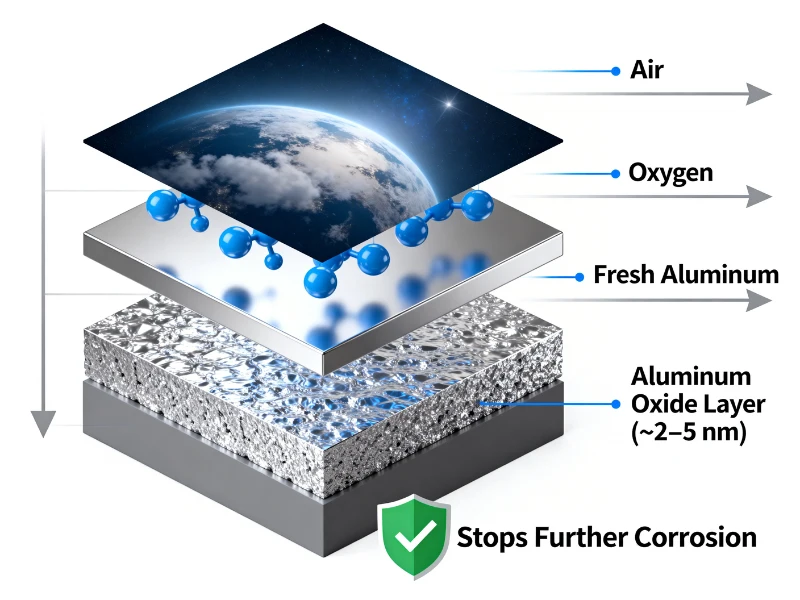
Understand the science behind aluminum’s corrosion resistance. This diagram shows how a thin, dense layer of aluminum oxide (corundum) immediately seals the surface upon exposure to air. Unlike iron rust, this 2-5 nm protective layer prevents oxygen and moisture from causing further damage, perfectly aligning with the “self-healing” nature of aluminum.
Where Aluminum Actually Loses
None of this makes aluminum bulletproof. It has a real weakness, and it’s not corrosion.
Steel has a fatigue limit. Keep the stress on a steel part below a certain threshold and it will never crack from repeated flexing, no matter how many cycles it goes through. Aluminum doesn’t have that floor. Every load cycle — every bump in the road, every pressurization event on a flight — does a little bit of damage that never fully resets. Given enough cycles, at any stress level, an aluminum part eventually cracks.
That sounds worse than it is in practice. Engineers don’t need a magic stress-free zone. They need the part to outlast its service life, and that’s a solvable design problem — you calculate the expected cycles over the part’s lifetime and keep cumulative damage below the failure threshold.
Aircraft take this seriously enough to put a number on it. A Boeing 737 is rated for 75,000 pressurization cycles before mandatory retirement. That’s not a soft guideline. It’s a hard cutoff, tracked per aircraft, enforced by routine inspection. Cars don’t get anywhere near that kind of scrutiny, and it shows: people scrap rusted-out steel frames all the time. Nobody’s scrapping a car for aluminum fatigue. The math works out fine at automotive mileages.
Why Detroit Fought the Switch Anyway
If aluminum resists corrosion this well, why did it take so long to show up in car bodies?
Forming automotive aluminum extrusions into body panels is harder than forming steel. Ford found that out the expensive way when it switched the F-150 to an aluminum body—new tooling, new welding techniques, body shops across the country having to relearn how to work on the thing. It was a genuinely big investment, not a marketing decision.
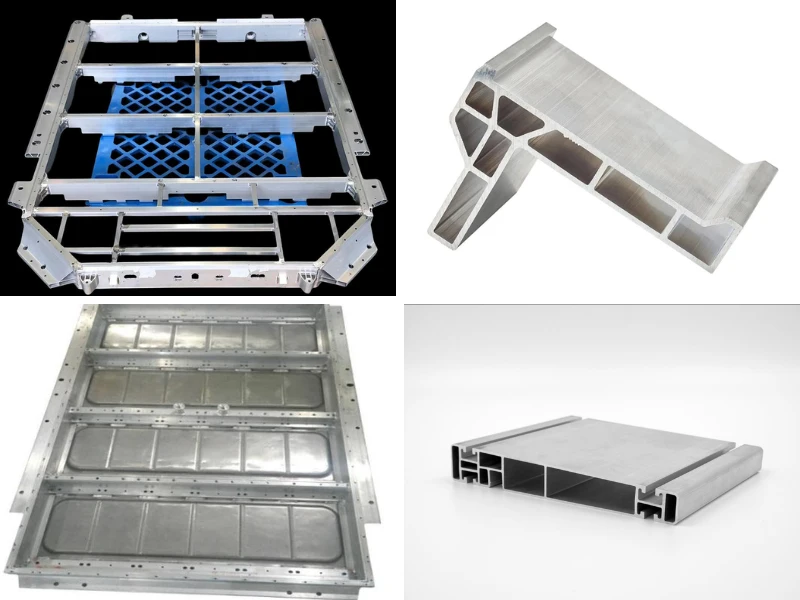
Explore our custom aluminum extrusions designed for the automotive industry, featuring multi-chamber crash beams, battery tray frames, and roof rails. These lightweight, high-strength profiles rely on aluminum’s inherent corrosion resistance to endure harsh road conditions and salt exposure.
The marketing came after. Slap “military-grade” in front of “aluminum” and the strength argument mostly takes care of itself, whether or not it’s the strongest metal in the truck.
Corrosion resistance was never the hard part. Getting people to build with the metal—and trust it once they had—always was.