Why Are Automotive Parts Materials Comprehensively Shifting to Aluminum?
In the past, automobile manufacturing relied heavily on heavy steel. Today, whether in traditional internal combustion engine vehicles or modern electric vehicles, the “aluminum replacing steel” trend is being vigorously promoted. The core reason lies in the lightweight advantage of aluminum, which can significantly reduce the curb weight of the vehicle, thereby lowering energy consumption. For electric vehicles, this directly translates into extended driving range.
Furthermore, unlike steel, which is prone to rusting, aluminum possesses natural corrosion resistance. It forms a protective oxide film on its surface, protecting the car’s undercarriage components from erosion even when driving in rain, snow, or on roads covered with de-icing salt. Through the extrusion process, SH-ALUMINUM can effortlessly shape aluminum into various complex profiles to meet increasingly stringent automotive structural requirements.
Why Did the Automotive Industry Stick with Steel in the Past Instead of Directly Using Aluminum Alloys?
The automotive industry’s long-standing adherence to steel in the past was not because aluminum alloys weren’t good enough. Rather, under the strict cost constraints of mass production, steel’s one-third stiffness cost, simpler welding processes, more reliable fatigue durability, and lower repair costs formed a formidable barrier that aluminum could hardly overcome for decades.
What Impact Has the Rise of New Energy Vehicles Had on the Use of Automotive Aluminum Alloys?
It is not simply a matter of “selling a few more tons of aluminum.” It has completely restructured the position of aluminum alloys in the industrial system—from demand scale and application scenarios to technological routes and the underlying logic of the entire industry chain.
Over the past 100 years, aluminum alloys served merely as “icing on the cake” auxiliary materials in cars; now, they have become core strategic materials that determine the performance and cost of new energy vehicles. The rise of new energy vehicles is not a minor interlude for the aluminum alloy industry, but a super-cycle lasting more than 20 years. It has fundamentally changed the industry’s nature, transforming it from a cyclical construction material sector into a growth-oriented high-tech material sector.
What Are the Advantages of Automotive Aluminum Profiles Compared to Steel?
Simply put, the “lower limit” of steel is very stable, but the “upper limit” of aluminum is exceptionally high. As the automotive industry begins to pursue ultimate performance, the advantages of aluminum become irreplaceable.
- Systematic Weight Reduction: This is the most core and intuitive advantage. The density of aluminum is about 2.7g/cm³, whereas steel is 7.85g/cm³; aluminum is only one-third the weight of steel. But this advantage goes beyond numbers—there is a “lightweight spiral” effect in automobiles: once the car body becomes lighter, systems such as brakes, suspensions, batteries, and motors can be correspondingly designed smaller and lighter, amplifying the overall vehicle weight reduction effect.
- High “Specific Strength”: Steel has a higher absolute strength under the same volume. However, looking at it from another dimension—strength under the same weight (specific strength)—the situation is reversed. Through proper alloy formulations and heat treatments, aluminum alloys can achieve strengths similar to regular automotive steel while weighing only one-third as much. This means designers can make part cross-sections thicker and structures more complex without adding weight, thereby achieving greater overall rigidity.
- Crush Energy Absorption and More Controllable Collision Safety: Greater hardness does not equate to better energy absorption. The hardness of steel is rigid; the hardness of aluminum is “energy-absorbing.” During a collision, aluminum alloys exhibit excellent crush and energy-absorption characteristics. When deforming, they can absorb and disperse massive impact kinetic energy more stably and evenly than steel, acting like a precisely calculated buffer zone.
- Natural Corrosion Resistance: Steel’s greatest enemy is rust. Aluminum alloys, however, naturally generate a dense oxide film in the air. This film is highly stable and effectively prevents further oxidative corrosion of the inner metal. The risk of “rust-through” in an all-aluminum body is far lower than in a steel body, an advantage that is particularly pronounced in areas with constant humidity or where de-icing salts are used.
- Excellent Heat Dissipation: The thermal conductivity of aluminum is much higher than that of steel. This is crucial for heat-sensitive core components like batteries and motors. Therefore, battery enclosures, motor controller housings, and radiators are almost exclusively dominated by aluminum.
- Recycling and Environmental Protection: Producing one ton of primary aluminum is indeed very electricity-intensive, but producing one ton of recycled aluminum consumes only about 5% of the energy required for primary aluminum. The recycling and reuse system for automotive aluminum is already highly mature, and the scrap value of aluminum after vehicle decommissioning is far higher than that of scrap steel.
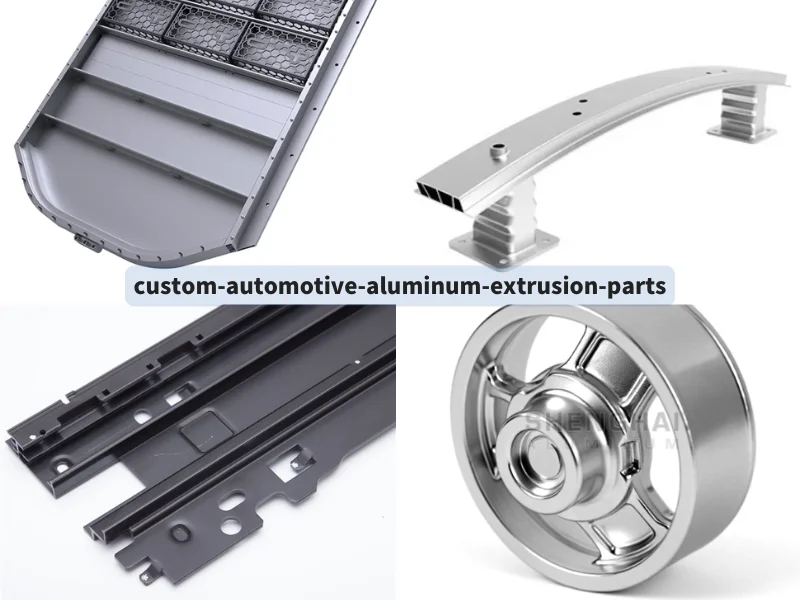
A diverse collection of precision aluminum extrusion components for the automotive industry, featuring lightweight EV battery trays, crash-absorbing bumper beams, and custom CNC machined profiles manufactured by SH-ALUMINUM.
SH-ALUMINUM’s Featured custom automotive aluminum extrusion
As a professional aluminum extrusion fabrication OEM, SH-ALUMINUM provides overseas clients with a one-stop service from aluminum billet extrusion to finished deep processing. Currently, the most popular products on our production lines among automakers and Tier 1 suppliers include:
- EV battery enclosure aluminum extrusion: A sturdy yet lightweight cavity structure that not only protects the high-voltage battery pack inside but also helps the battery dissipate heat efficiently.
- Aluminum bumper beam: As an experienced aluminum bumper beam manufacturer, we provide energy-absorbing profiles with high yield strength. In the event of a collision, they effectively absorb impact forces, protecting the passengers inside the vehicle.
- Extruded aluminum sunroof guide rails and roof racks: Dimensionally precise, smooth-surfaced, and highly durable roof structural components.
- Lightweight aluminum chassis components: Lightweight subframes, control arms, and other chassis components used to support the weight of the vehicle body and connect the wheels.
Production Process of Your Reliable automotive aluminum alloy supplier
As an overseas buyer, you do not need to worry about complex manufacturing processes; all stages are completed in a closed loop within our facility:
- custom automotive aluminum extrusion: You only need to provide the CAD drawings, and we can open the mold and extrude the aluminum into your precise required cross-section.
- aluminum profile CNC machining services: We use large-scale CNC machine tools to perform high-precision cutting, drilling, and milling on the extruded profiles, ensuring every hole perfectly aligns with your vehicle.
- Surface Treatment: Based on your anti-corrosion requirements, we offer anodizing or powder coating services, giving the parts a tough protective outer layer.
Why Choose SH-ALUMINUM as Your Partner?
Finding a stable and reliable automotive parts contract manufacturer is no easy task, but we are confident that you will choose us:
- Strict Quality Inspection: We conduct rigorous geometric tolerance and visual inspections on every batch of outgoing parts to eliminate any scratches or assembly errors.
- Qualified IATF 16949 aluminum extrusion supplier: We deeply understand the importance of automotive safety. Our production processes strictly benchmark against the IATF 16949 quality management system to ensure product consistency.
- Commitment to On-Time Delivery: Automotive production lines must never halt due to material shortages. We have flexible production capacity to ensure every order is loaded into containers and shipped to the destination port on schedule.