
Why aluminum profile cutting and precision blanking matter — tolerances, right-angle, 45°, CNC, punching, sawing, and deburring explained.
Simply put, the significance of aluminum profile cutting and precision blanking boils down to three key objectives: transforming raw, long stock into usable components; locking dimensional tolerances strictly within the range permissible for assembly; and paving the way for subsequent processes such as powder coating, corner assembly, and shipping.
The material extruded from our presses arrives in 6-meter lengths; without cutting them down to size, they are completely unusable for manufacturing door and window frames, equipment racks, or photovoltaic mounting systems. If a cut is misaligned—off by a millimeter in length or half a degree in perpendicularity—the consequences are severe: gaps appear during on-site assembly, corner brackets cannot be inserted, and even the finest subsequent powder coating becomes entirely futile. Conversely, if dimensions are controlled within a tolerance of ±0.1mm and the end faces are clean and burr-free, corner joints will fit tightly and coatings will adhere firmly. This ensures that when shipments reach customers in Southeast Asia or Europe, the components are ready for immediate assembly—requiring nothing more than tightening screws—and allows us to reliably meet delivery deadlines of 15 to 20 days. Ultimately, precise blanking is the critical foundation that ensures the smooth and efficient operation of the entire downstream processing line.
What Are the Different Types of Aluminum Profile Cutting and Precision Blanking?
1. Right-Angle Cutting of Aluminum Profiles
Right-angle cutting constitutes the fixed-length end-facing stage of profile processing, wherein a saw blade executes a vertical plunge cut to section long stock into components featuring 90-degree end faces. Leveraging the 7 extrusion lines housed within our 23,000 m² production facility, we perform precision cutting operations. Length tolerances are strictly controlled using CNC-controlled length stops, ensuring that the resulting components are perfectly square and true.
2. Aluminum Profile 45° Angle Cutting
45° miter cutting involves tilting the saw blade to slice the profile's end face into a 45° bevel; when paired, two such pieces join perfectly to form a 90° right angle. When manufacturing door and window system profiles or aluminum furniture frames, we utilize double-head saws to cut angles simultaneously at both ends. Our precision angle gauges ensure a strict tolerance of ±0.5° or less.
3. CNC Precision Cutting & Fixed-Length Cutting
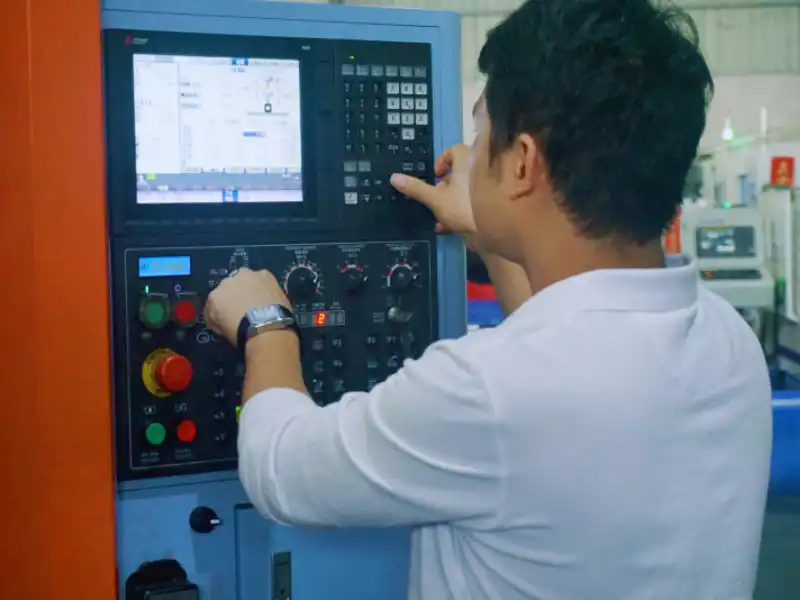
CNC Precision Cutting involves a CNC control system driving servo motors to execute the cut. Simply input the target length and cutting quantity into the HMI interface, and the carbide saw blade automatically performs the cut. Our closed-loop control system rigorously monitors tolerances; achieving an accuracy of ±0.1mm is routine.
4. Punching Process
The punching process involves a die driving a punch downward; once the required tonnage is applied, the profile is instantly pierced—creating necessary holes or notches—in a single-step forming operation.
5. Sawing Process
Sawing involves a carbide-tipped saw blade rotating at high speed to cut long profile stock into specific, fixed lengths as required.
6. Deburring Process
Deburring involves cleaning up the end face of a profile after it has been cut by the saw blade—specifically removing any sharp burrs that could cut one's hands or fine aluminum shavings that have curled up during the cut.