Which alloy should you machine? Compare 6061, 6082, 7075 and five other grades by machining behaviour, properties and tooling — and choose by requirement.
6061-T6 is often the practical starting point for general-purpose CNC aluminum parts — but it is not the best alloy for every machining job.
When selecting aluminum for CNC milling, turning or drilling, machinability is only one consideration. Strength, corrosion resistance, chip formation, dimensional stability, surface finish, material availability and total manufacturing cost all influence the final choice. 6061-T6 is widely used because it balances these properties well. 6082-T6 is frequently specified in European markets, 7075-T6 is chosen for high-strength components, and free-machining grades such as 2011 are attractive in high-volume production where chip control drives cycle time. If you are comparing alloys for a specific part, our CNC machining services team can review the drawing and recommend a route.
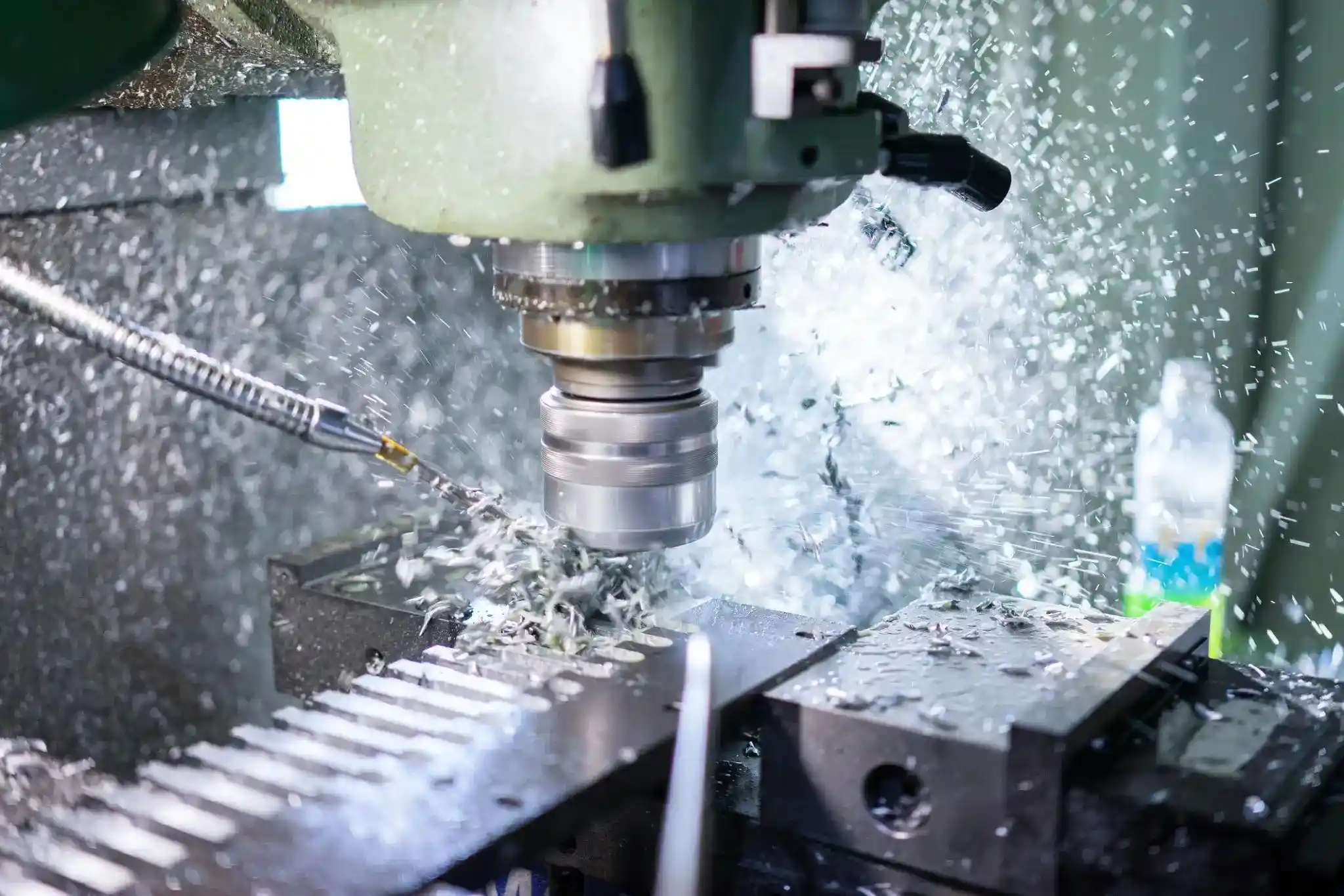
Aluminum Machinability Chart: Alloy Comparison
Machinability ratings published by different sources are not directly comparable. Some are relative to a specific steel, some to a specific aluminum grade, and some are simply shop-floor assessments. The table below therefore describes machining behaviour and the main consideration for each alloy rather than ranking them by productivity.
Alloy | Typical machining behavior | Main machining consideration |
|---|---|---|
2011 | Excellent chip breaking | Corrosion resistance and material specification |
6262 | Good chip control | Alloy availability and specification |
6061 | Versatile, generally easy to machine | Chip evacuation and built-up edge |
6082 | Similar to 6061 | Product form and cutting conditions |
7075 | Good machinability, good finish potential | Material cost and corrosion protection |
2024 | Generally good machinability | Corrosion protection |
6063 | Machinable, relatively soft | Thin-wall deformation and burrs |
5052 | Ductile, potentially long chips | Sharp tooling and chip control |
5083 | Ductile, may produce long chips | Chip evacuation and workholding |
3003 / 1100 | Soft, prone to smearing and burrs | Sharp tooling and lubrication |
The practical takeaway: alloys higher in this table are generally easier to run at high removal rates, but "more difficult to machine" does not mean "cannot be machined". Tooling and cutting parameters influence the outcome as much as the alloy does. If you want a narrower comparison, see our guide to the five popular aluminum alloys for CNC machining.
Aluminum Alloy Properties for CNC Machining
The values below are typical reference values, compiled from Aluminum Association published data, ASTM and EN material standards, and supplier datasheets. Properties vary with product form (plate, bar, extrusion), thickness, temper and the applicable standard. For example, the 6082-T6 figures should not be read as guaranteed values for every product form or specification. For design and certification, use the mill certificate or the values in the relevant standard (for example EN 755-2 or ASTM B221).
Alloy / temper | UTS (MPa) | Yield (MPa) | Hardness (HB) | Thermal conductivity | Corrosion resistance |
|---|---|---|---|---|---|
2011-T3 | ~380 | ~295 | ~95 | ~150 W/(m·K) | Limited (copper-bearing) |
6061-T6 | ~310 | ~276 | ~95 | ~167–180 W/(m·K) | Good |
6082-T6 | ~310 | ~260 | ~95 | ~170 W/(m·K) | Good |
2024-T4 | ~470 | ~325 | ~120 | ~121 W/(m·K) | Fair; usually protected |
7075-T6 | ~570 | ~505 | ~150 | ~130 W/(m·K) | Lower than 6xxx |
6063-T5 | ~185 | ~145 | ~60 | ~200 W/(m·K) | Very good |
5052-H32 | ~230 | ~195 | ~60 | ~138 W/(m·K) | Good |
5083-H116 | ~305 | ~230 | ~75 | ~117 W/(m·K) | Good |
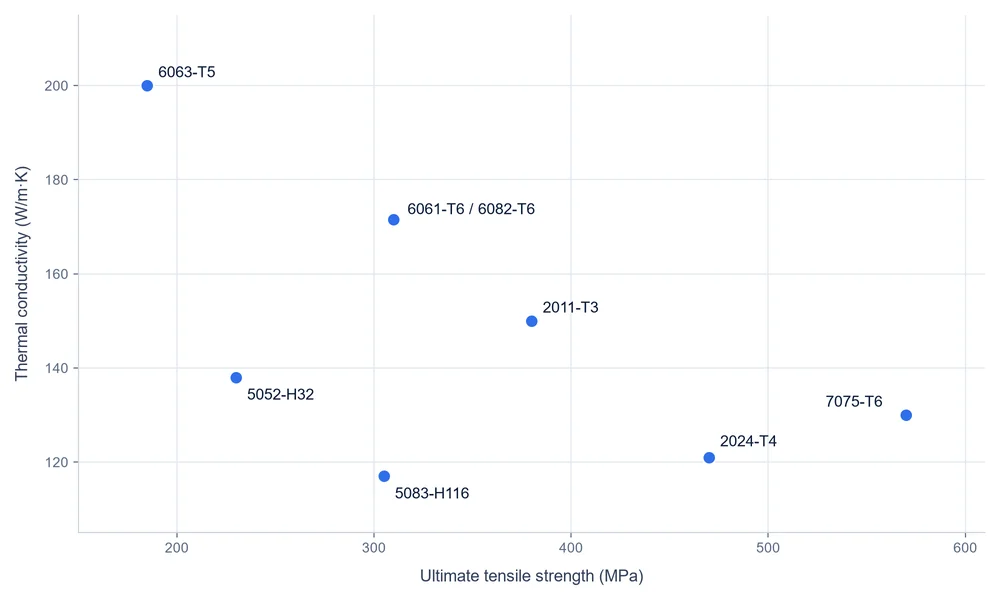
Two practical notes. First, in many product forms 6061 and 6082 sit at similar strength levels; neither is universally stronger. Second, thermal conductivity matters as much as strength in heat sinks and electronic housings, which is why 6063 and 6061 appear in extruded aluminum heat sinks far more often than 7075.
6061 vs 6082: Which One Should You Choose?
Both are 6xxx alloys with magnesium and silicon as the main alloying elements, and both machine and anodize well. The difference is mainly commercial and regional rather than a fixed performance gap.
- 6061-T6 is the default in North America and is stocked almost everywhere. It is the safer choice when the supply chain is global and the drawing does not specify a European standard.
- 6082-T6 is common in European structural work and is often called out on drawings from Germany, the UK and Scandinavia. Its strength in a given product form may be higher or lower than 6061 depending on thickness and temper, so the two are not automatically interchangeable on a structural part.
On the machine, 6082-T6 and 6061-T6 generally behave similarly. Cutting parameters should be adjusted for stock form, tool geometry, machine rigidity, chip evacuation and finish requirement rather than applying a fixed speed offset to one alloy.
If a drawing specifies 6082, do not substitute 6061 without checking the structural requirement. If it specifies 6061, paying a premium for 6082 rarely buys anything on a non-structural part.
7075-T6: Machinability and High-Strength Applications
7075-T6 is a zinc-bearing alloy with substantially higher strength than 6061 — UTS around 570 MPa versus around 310 MPa, roughly 1.8×, with yield strength approaching twice that of 6061 depending on product form. Its machinability is good: chips break cleanly and surface finish is usually good. It is selected for strength requirements, material cost and corrosion considerations rather than because it is difficult to machine.
Where 7075 needs attention:
- Corrosion. It is less corrosion-resistant than most 6xxx alloys. Depending on the environment, service life, appearance requirements and customer specification, anodizing, conversion coating, painting or another protective treatment may be required. Bare 7075 can still be used where the application and environment permit it.
- Threads and wear. Aluminum threads wear faster than steel; threaded inserts or helicoils are common in assemblies that are taken apart repeatedly, regardless of alloy.
- Cost. It is significantly more expensive per kilogram than 6061, so it belongs where strength genuinely drives the design: aerospace fittings, high-load fixtures, motorsport and bicycle components.
Which Aluminum Alloys Are More Difficult to Machine?
No alloy is impossible to CNC machine. Some alloys simply need different tooling and strategies.
5052 and 5083 are not usually the first choice for high-speed precision machining. Their soft, ductile structure can produce long chips, built-up edge and poor surface finish when tooling and parameters are poorly matched. They are, however, machined successfully in large volumes for marine components, housings, plates and fixtures where corrosion resistance matters more than removal rate. Sharp edges, higher rake angles, adequate lubrication and reliable chip evacuation make a significant difference.
3003 and 1100 are very soft and ductile. The typical issues are smearing, built-up edge, long chips and burrs rather than hardness. Sharp cutting edges, generous rake, suitable lubrication and good chip evacuation are the usual countermeasures.
6063 is widely used for extrusion — architectural profiles, heat sinks, complex sections — and it can also be machined. Its limitations come from lower strength and a softer temper, which can cause clamping distortion and smearing on thin sections, not from any inherent inability to be cut.
Aluminum CNC Machining Speeds and Feeds
The table below is illustrative, not a machining standard and not a productivity ranking between alloys. Actual parameters depend on tool manufacturer data, tool diameter and geometry, spindle capability, radial and axial engagement, workholding, coolant and chip evacuation. Always start from the tool supplier's recommendation for the specific tool.
Operation | Tool example | Indicative surface speed | Indicative feed | Note |
|---|---|---|---|---|
Face / pocket milling | 3-flute carbide, Ø10 mm | 200–400 m/min | 0.05–0.15 mm/tooth | Adjust depth, feed and speed to cutting load |
Slotting | 2–3 flute carbide | 150–300 m/min | 0.04–0.10 mm/tooth | Full-width cuts need conservative feed |
Drilling (carbide) | Selected by hole size | 50–100 m/min | 0.08–0.25 mm/rev, varies with diameter | Feed depends strongly on drill diameter |
Drilling (HSS) | Selected by hole size | 25–50 m/min | 0.10–0.25 mm/rev, varies with diameter | Coolant and chip evacuation limit the range |
Tapping (form tap) | Form tap | 8–25 m/min | — | Hole size must suit material displacement |
Tapping (cut tap) | Spiral-flute tap | 10–30 m/min | — | Chip evacuation is the limiting factor |
Turning | Positive-rake carbide | 250–600 m/min | 0.10–0.35 mm/rev | Upper end requires specific tooling and rigidity |
There is no fixed pecking rule. Pecking depth should follow the drill supplier's recommendation and be adjusted for drill type, coolant, chip evacuation and hole depth.
How to establish parameters for a new job
- Start from the tool supplier's recommendation for the alloy family and the specific tool.
- Adjust radial and axial engagement, feed and speed together according to cutting load — do not rely on reducing speed alone.
- Run a first-article cut and inspect chip formation. Chip shape is influenced by feed, tool geometry and chip evacuation together, not by a single parameter.
- Check surface finish and measure a critical dimension before scaling the program.
- Record proven parameters per alloy, tool and operation; that shop-specific record is more valuable than any generic table.
Aluminum Machining Tools: What Works
- Flute count. 2–3 flute end mills are commonly used for aluminum because they provide chip space, particularly in slotting and high-removal roughing. Higher flute counts can also work well in finishing when chip evacuation and tool engagement are controlled.
- Geometry. Polished flutes and high-helix designs are widely used to reduce chip adhesion and improve evacuation. The appropriate helix angle depends on the operation, so refer to the tool supplier's data rather than a fixed number.
- Coating. Polished uncoated carbide is often the first choice for aluminum and performs well. Where adhesion or tool life becomes an issue, coatings such as ZrN or DLC can help under suitable conditions.
- Rake and edge. Sharp, positive geometry is generally preferred. Aluminum does not tolerate dull edges or heavy negative rake well.
- Chip evacuation. In pockets and deep slots, recutting is the main cause of built-up edge and tool damage. Flood coolant, high-pressure air and minimum quantity lubrication can all work; the right choice depends on tool design, machine capability and chip-control requirements. Dry machining is possible in some operations with the correct tooling and air blast, but it demands disciplined chip evacuation.
How to Select the Right Aluminum Alloy for Your Part
Start with the requirement, then choose the alloy.
Application requirement | Recommended alloy | Why |
|---|---|---|
General-purpose CNC components | 6061-T6 | Balanced machinability, strength, corrosion resistance and availability |
High-strength, weight-critical parts | 7075-T6 | Higher strength-to-weight ratio; cost and corrosion trade-offs apply |
European structural components | 6082-T6 | Commonly specified structural alloy in European markets |
High-volume production machining | 2011, 6262 or similar free-machining grades | Good chip formation and productivity; corrosion limits apply |
Marine or salt-exposed components | 5052 / 5083 | Good corrosion resistance, particularly in marine and salt-exposed applications |
Extruded components with secondary machining | 6061 / 6063 / 6082 | Selection depends on profile geometry, strength and machining requirements |
Heat sinks and electronic housings | 6061 / 6063 | Good conductivity, finishing response and cost |
Sheet-metal fabrication | 5052 | Formability and corrosion resistance |
If the requirement is already clear, send the drawing and we will quote it as a custom machined part — extrusion, machining and finishing included.
Frequently Asked Questions
What is the best aluminum for CNC milling?
There is no single best alloy. 6061-T6 is the practical default for general parts; 7075-T6 is selected when strength-to-weight drives the design; 6082-T6 is common for European structural specifications; 2011 and 6262 suit high-volume work where chip control dominates.
What is the machinability of 6061 aluminum?
6061-T6 is generally considered easy to machine, producing manageable chips and good surface finish under suitable cutting conditions. Chip formation can deteriorate with inappropriate feed, tool geometry or chip evacuation.
Is 7075 harder to machine than 6061?
7075-T6 is not inherently difficult to machine. Its higher strength may affect cutting forces and tool selection, but achievable machining productivity depends on tooling, machine rigidity, engagement and workholding. Material selection is usually driven by strength, cost and corrosion requirements.
Can you machine 5052 or 5083?
Yes. They are more ductile and prone to built-up edge than 6xxx alloys, so they need sharp tooling, appropriate rake, good lubrication and reliable chip evacuation. They are routinely machined for marine and corrosion-resistant parts.
What aluminum cutting speed should I use?
Start with the tool supplier's recommendation for the alloy and the specific tool, then adjust for engagement, rigidity and chip evacuation. Published ranges are starting points, not standards.
6082 vs 6061 — can they be substituted?
They are similar in many respects, but they are different alloys with different specification bases and property guarantees. Substitution on a structural or certified part should be confirmed against the drawing and the applicable standard.
Which aluminum alloy is best for anodizing?
6xxx alloys, particularly 6061 and 6063, anodize uniformly and predictably. 7075 contains zinc and copper and can produce a darker, less uniform finish, which matters for cosmetic parts.
We run extrusion, CNC machining, deburring, anodizing and powder coating in one facility. More detail on our manufacturing capabilities.
Need Help Selecting the Right Aluminum Alloy?
Choosing the right alloy affects machining efficiency, dimensional accuracy, surface finish and total manufacturing cost. Send us your drawings and operating conditions, and our team will help identify a suitable alloy and machining approach.